
Recipe Details
Traditional Ethiopian Injera (Quick Fermented Method)
Updated: Aug. 26, 2024
Overview
Prep Time: 5 minutes (active prep, excluding fermentation)
Fermentation Time: 48 hours (room temperature, 68–72°F / 20–22°C ideal)
Cook Time: 20 minutes (active cooking)
Total Time: 25 minutes + 48 hours (active time + fermentation)
Yield: 8–10 small (12-inch) injera
Ingredients
Primary Ingredients:
2 cups (280g) teff flour (ivory or brown; stone-ground for texture)
2 cups (480ml) filtered water (room temperature)
1½ teaspoons (6g) aluminum-free baking powder
¼ teaspoon (1g) fine sea salt
Substitutions & Adaptations (from community feedback):
Buckwheat Flour: Replace teff 1:1; omit baking powder, ferment 12–24 hours (faster in warm climates).
Wheat Blend: Add ½ cup all-purpose flour to teff for elasticity (reduces difficulty in forming holes).
Pre-Made Option: Use freshly prepared injera from local Ethiopian markets (convenient shortcut).
Instructions
Step 1: Prepare Fermented Batter
In a large non-reactive bowl, whisk teff flour and water until smooth (consistency: thin pancake batter).
Key: Scrape sides to incorporate all batter; slight gritty texture is normal for teff.
Cover with a clean towel and ferment undisturbed in a cool, dark place (pantry) for 48 hours.
Step 2: Check Fermentation
After 48 hours, the batter should:
Smell sour (lactic acid fermentation).
Have a puffy, cracked "brain-like" surface.
Separate into liquid (whey) at the bottom.
Action: Stir the separated liquid back into the batter to restore consistency.
Step 3: Preheat & Prepare Workstation
Lay dry towels on a surface (cooling area) and parchment paper nearby.
Thoroughly wipe a 12-inch nonstick pan and lid with a cloth to remove oils.
Step 4: Adjust Batter & Heat Pan
Fold baking powder and salt into the fermented batter (stir gently; expect deflation).
Heat the pan over medium-high for 2 minutes (test: water evaporates in 5 seconds).
Step 5: Spread & Cook Injera
Scoop ½ cup batter into the pan’s center; quickly tilt/rotate to spread thinly (1/16-inch thick).
Cook undisturbed for 1 minute (edges curl slightly).
Step 6: Finish Cooking
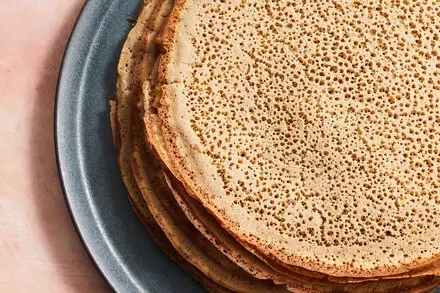
After 1 minute, check for "eyes" (tiny holes) covering 75% of the surface.
Cover for 30 seconds, then remove condensation from the lid.
Step 7: Remove & Cool
Nudge injera off the pan (don’t lift) onto a towel.
Check underside: smooth = good; holes = reduce heat next batch.
Step 8: Repeat & Clean
Reheat pan/lid between batches; adjust heat to medium if injera cracks.
Use all batter, stacking cooled injera with parchment.
Step 9: Store & Reheat
Refrigerate stacked injera in a resealable bag for up to 2 weeks.
Reheat: Microwave 30–45 seconds or foil-reheat in a 350°F oven for 10 minutes.
Pro Tips & Community Insights
Fermentation: Extend to 72 hours in cool climates; add vinegar to enhance sourness.
Buckwheat Hack: Ferment 12–24 hours, skip baking powder (nutty flavor, faster).
Time-Saver: Use pre-made injera from local Ethiopian stores (better texture initially).
Note: 2–3 attempts may be needed to perfect texture; community feedback confirms patience is key!