
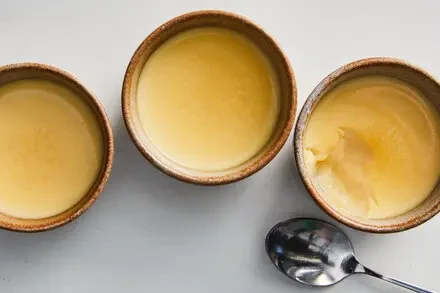
Recipe Details
Chawanmushi (Japanese Steamed Egg Custard)
Updated: April 23, 2025
Total Time: 20 minutes
Prep Time: 5 minutes
Cook Time: 15 minutes
Ingredients
For the Celery Root Purée (Optional)
½ small celery root (about 8 ounces), peeled and cut into large chunks
½ cup unsalted butter
¾–1 cup water (just enough to cover the celery root)
For the Chawanmushi
2 large eggs
⅓ cup/80 milliliters katsuo dashi (bonito stock), cooled
½ teaspoon usukuchi (light-colored) soy sauce
Preparation
1. Prepare the Celery Root Purée
In a small saucepan over medium heat, add the chopped celery root, water (to cover), and butter. Bring to a boil, then reduce heat to maintain a gentle simmer. Cook until the celery root is tender and most of the water evaporates (about 20 minutes).
Transfer the cooked celery root to a blender or food processor. Purée until smooth, adding a splash of the remaining cooking liquid if needed to reach a creamy consistency. Set aside.
2. Prepare the Chawanmushi Base
In a small bowl, beat the eggs thoroughly. Gradually add the cooled katsuo dashi in two batches, whisking well after each addition to ensure emulsification.
Strain the egg mixture through a fine sieve to remove any lumps, resulting in a silky texture. Season with usukuchi soy sauce and mix gently.
3. Steam the Chawanmushi
Divide the strained egg mixture evenly among four small ramekins (½ cup capacity or less). Cover each ramekin tightly with plastic wrap to prevent condensation from marring the surface.
Bring 1 inch of water to a gentle simmer in a large pot. Carefully place the covered ramekins in the simmering water (or a steamer basket) and cover the pot with a lid, leaving it slightly ajar to release excess steam.
Steam until set:
Direct pot method: 12–15 minutes
Steamer basket method: 15–18 minutes
To test doneness, insert a skewer into the center; it should emerge clean with no wet batter.
4. Serve (Optional Celery Root Purée)
Spoon 2–3 tablespoons of the celery root purée onto each chawanmushi before serving. Serve immediately to preserve texture.
Ingredient & Preparation Notes
Katsuo Dashi: A smoky, savory broth made by steeping kombu (dried kelp) and katsuobushi (smoked bonito flakes) in water. Source from Japanese markets or online; homemade: simmer 1 piece kombu + 5g katsuobushi in 2 cups water for 15 minutes, then strain.
Usukuchi Soy Sauce: A light-colored, saltier alternative to dark soy sauce, ideal for delicate flavors. Available in Japanese markets or online.
User Reviews
No, the plastic wrap stays on until the steaming is finished. You can also use a foil lid. The plastic/foil lid prevents condensation from getting into the custard, marking the surface with irregularities.
The texture and flavor turned out great. I missed the detail about plastic wrap so skipped that. No regrets—plus less microplastic in my food. Next time I’ll double the recipe and add more liquid for a true 4-serving yield. As written, I filled one 4” ramekin instead of splitting into two.
I substituted celery root with daikon radish (puréed) and it was delicious! The recipe’s water-to-celery root ratio was too high; ¼ cup water sufficed on low heat for 20 minutes, as the root releases natural moisture.
After 3 attempts, the best method was steaming with a foil lid (ajared) for 18 minutes. This yielded a silky, bubble-free custard. Classic Japanese chawanmushi traditionally includes seafood, but this vegetarian version shines with celery root’s earthiness.
The chawanmushi I had in 90s Japan always had seafood bits, but this pure custard is elegant. Perfect for breakfast or as a savory appetizer!
Ensure katsuo dashi is cooled to avoid scrambling eggs. For a richer custard, use a bit more dashi or a splash of mirin (optional).